Omega Elevators Logo

Travelators & Moving Walks

Some journeys can be long. Travelators carry passengers and their luggage across airport concourses, railway station passageways and retail floors on a continuous bed of moving flat pallets. Omega supplies heavy-duty units for transit and public infrastructure, alongside commercial units for retail and high-footfall complexes.

Discuss Your Project
Scroll for more
0° · 6° · 12°Inclination
Up to 1600 mmPallet Widths
0.5 – 0.65 m/sSpeed
Indoor & OutdoorInstallation
Overview

What is a travelator?

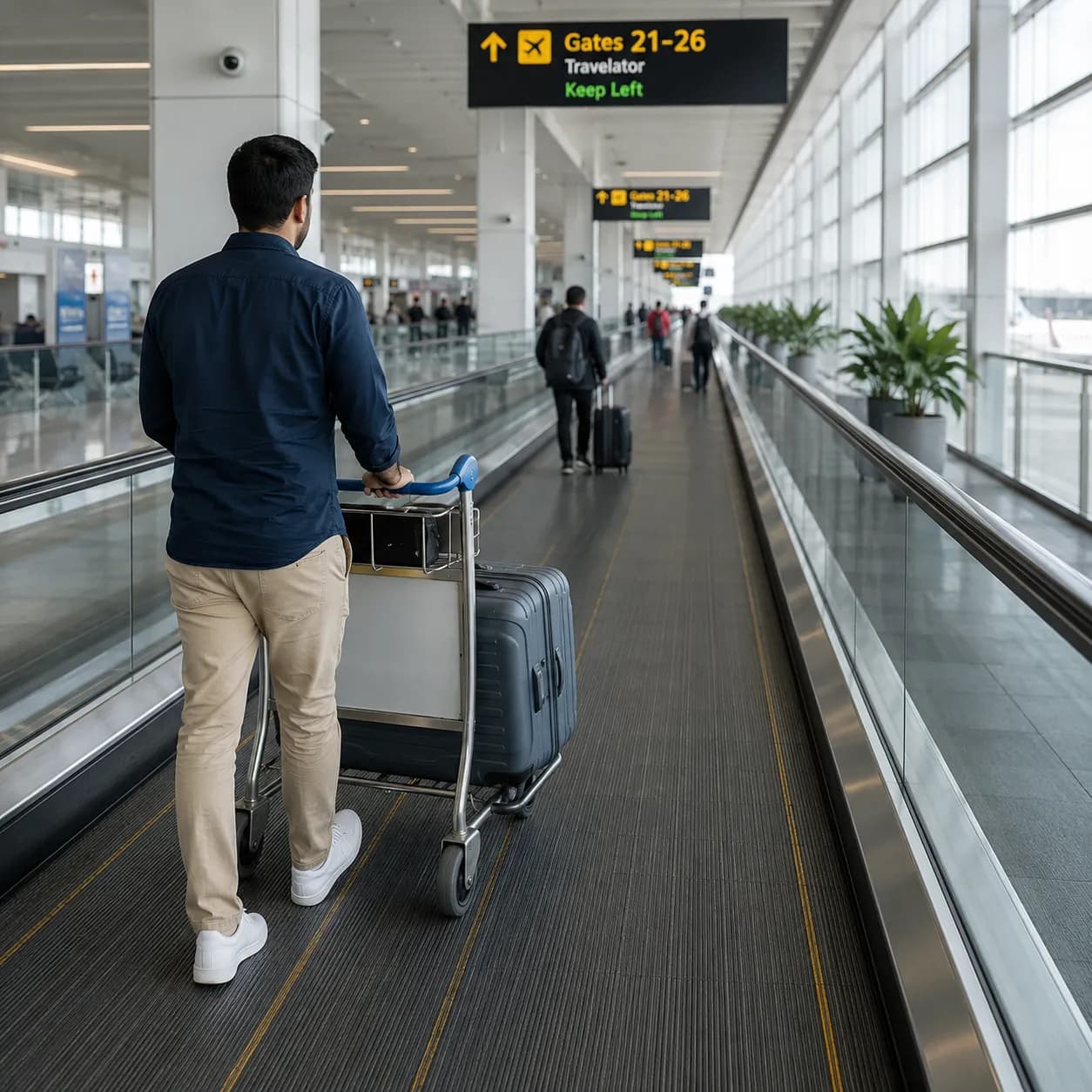
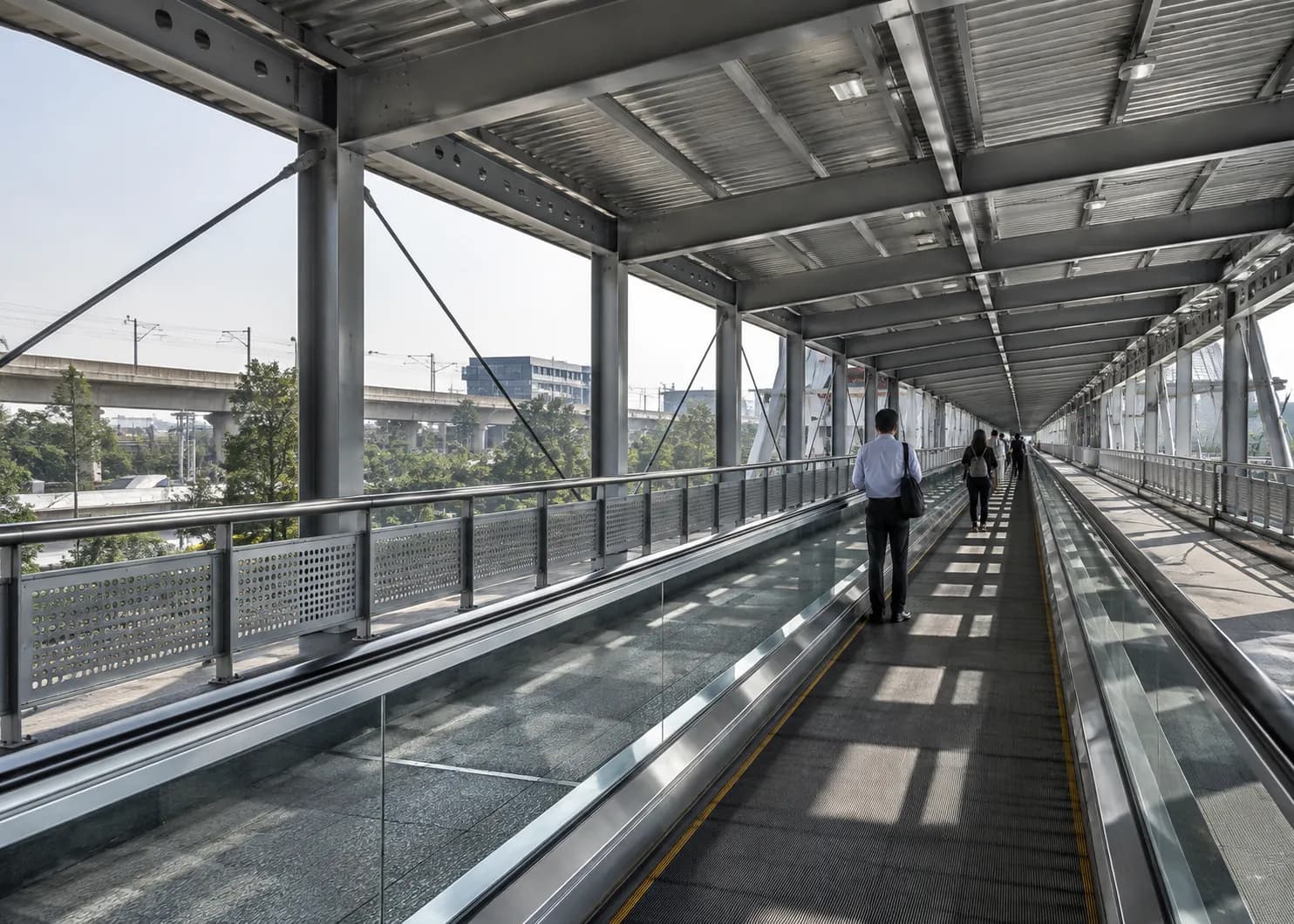
A travelator, also called a moving walk or moving walkway, is a motor-driven conveyor that carries passengers along a horizontal path or a gentle incline of up to 12 degrees. It uses a continuous band of flat pallets instead of steps, so luggage trolleys, shopping carts and strollers can be taken onto it.

Moving walkMoving walkwayAutowalkPassenger conveyor
Image — flat pallet band with a luggage trolley riding alongside its passenger, no step to negotiate
Decision Aid

Do you need a travelator or an escalator?

These are not competing products — they solve different problems and the wrong choice is expensive to discover at the drawing stage. The salient critical difference is that an escalator has steps, whereas a travelator has a flat pallet-like surface. The application depends on the unique specific need of the project. If there is a requirement for covering distance with a nominal height (up to 10 m), travelators are the correct mobility equipment. In case there is a vertical distance and height coverage is required, then escalators would be the appropriate choice.

Flat pallets for trolleys and distance. Steps for height in tight space.

DifferenceTravelator (Moving Walk)Escalator
Operating surfaceFlat palletsMoving steps
Inclination0° to 12°30° to 35°
Primary purposeDistance, or gentle level changeVertical movement between floors
Luggage trolleys & shopping cartsYes — the core reason to specify oneNo
Strollers and wheeled baggageYesNot safely
Space to achieve a given riseLong run requiredCompact footprint
Best forLong concourses, passageways, retail floors where trolleys must travelFloor-to-floor movement in constrained footprints
See Omega escalators
Duty Classes

Two travelator classes, defined by duty

The choice between a heavy-duty and a commercial travelator is not a preference — it follows from how hard the unit will work, where it stands and what a stoppage costs. Both use the same flat pallet band, the same control architecture and the same standard safety device set. Gradient, width and length are configured within each class.

Heavy-Duty Travelators

Transit & public infrastructure — continuous-duty pedestrian transport where the unit runs long hours under sustained load.

A heavy-duty travelator is specified where the run is long, the loading is sustained, the position may be exposed, and a stoppage has consequences beyond the unit itself. The build is weighted towards structural robustness, corrosion resistance and remote supervision rather than finish.

Where is it used?
Airports — concourses & inter-terminal passagewaysMultimodal transit interchangesLarge public complexesHigh-footfall visitor destinationsOutdoor and semi-enclosed circulation links
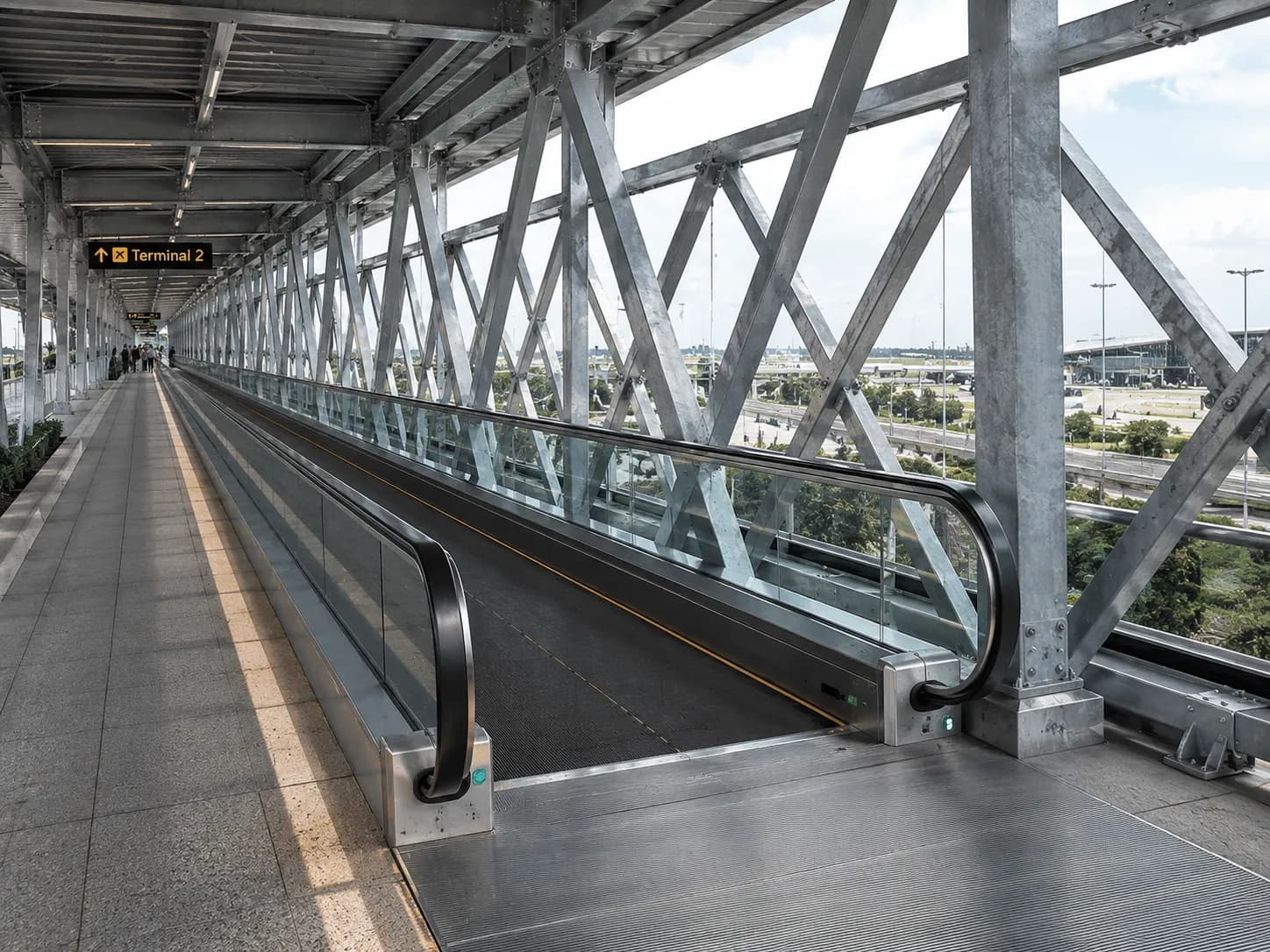
Image — heavy-duty travelator on a long outdoor transit link, hot-dip galvanised truss
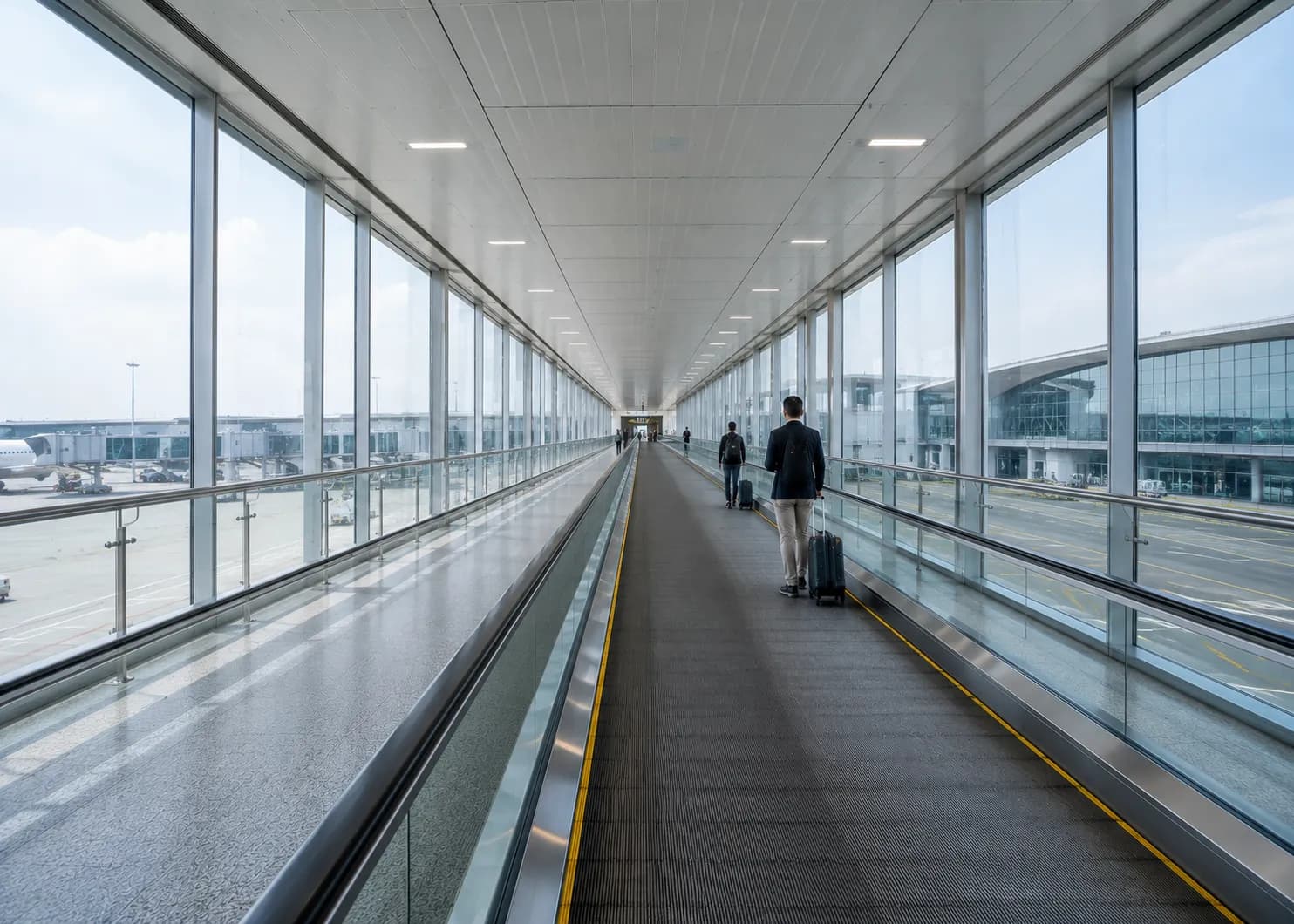
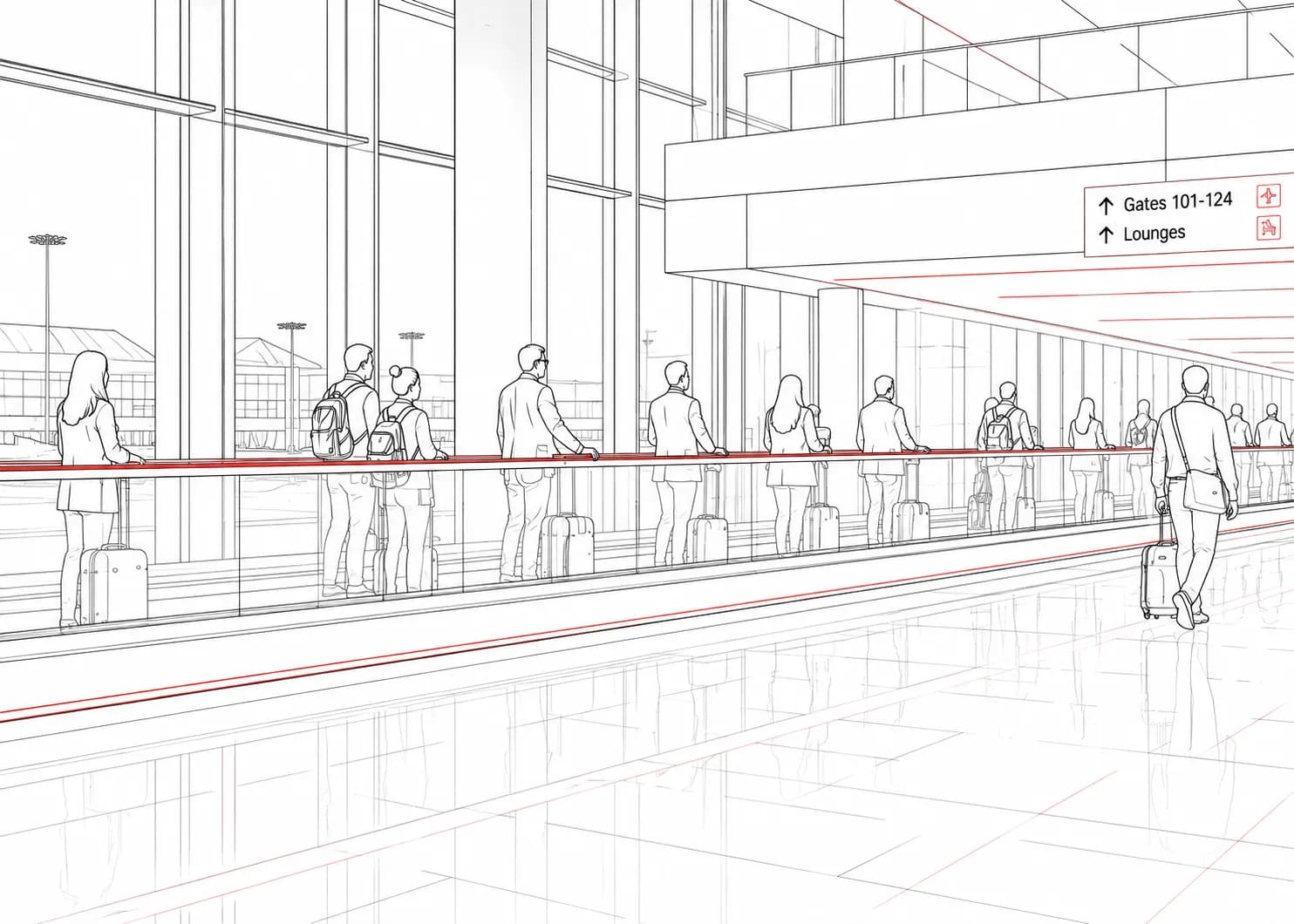
Image — airport inter-terminal passageway
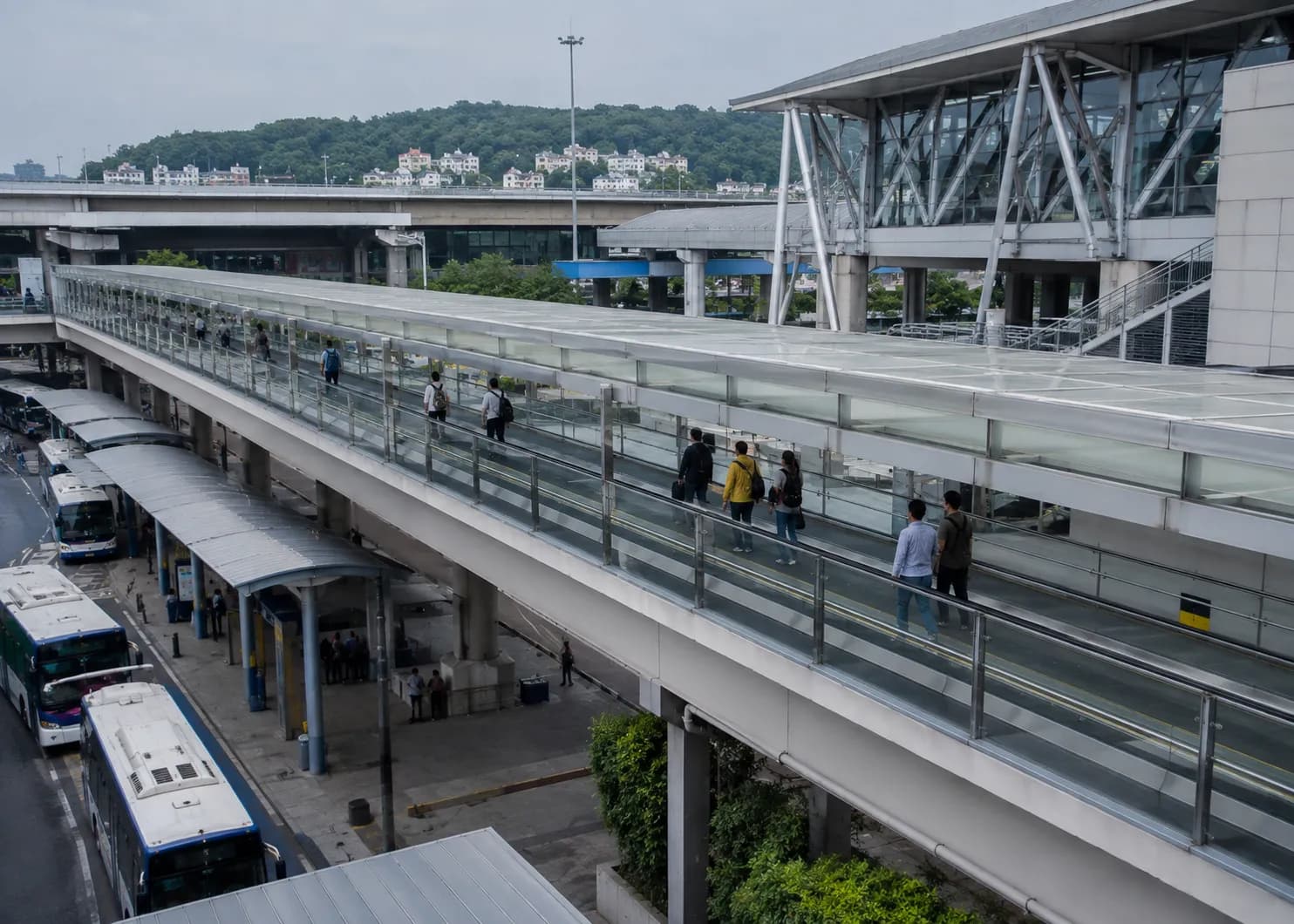
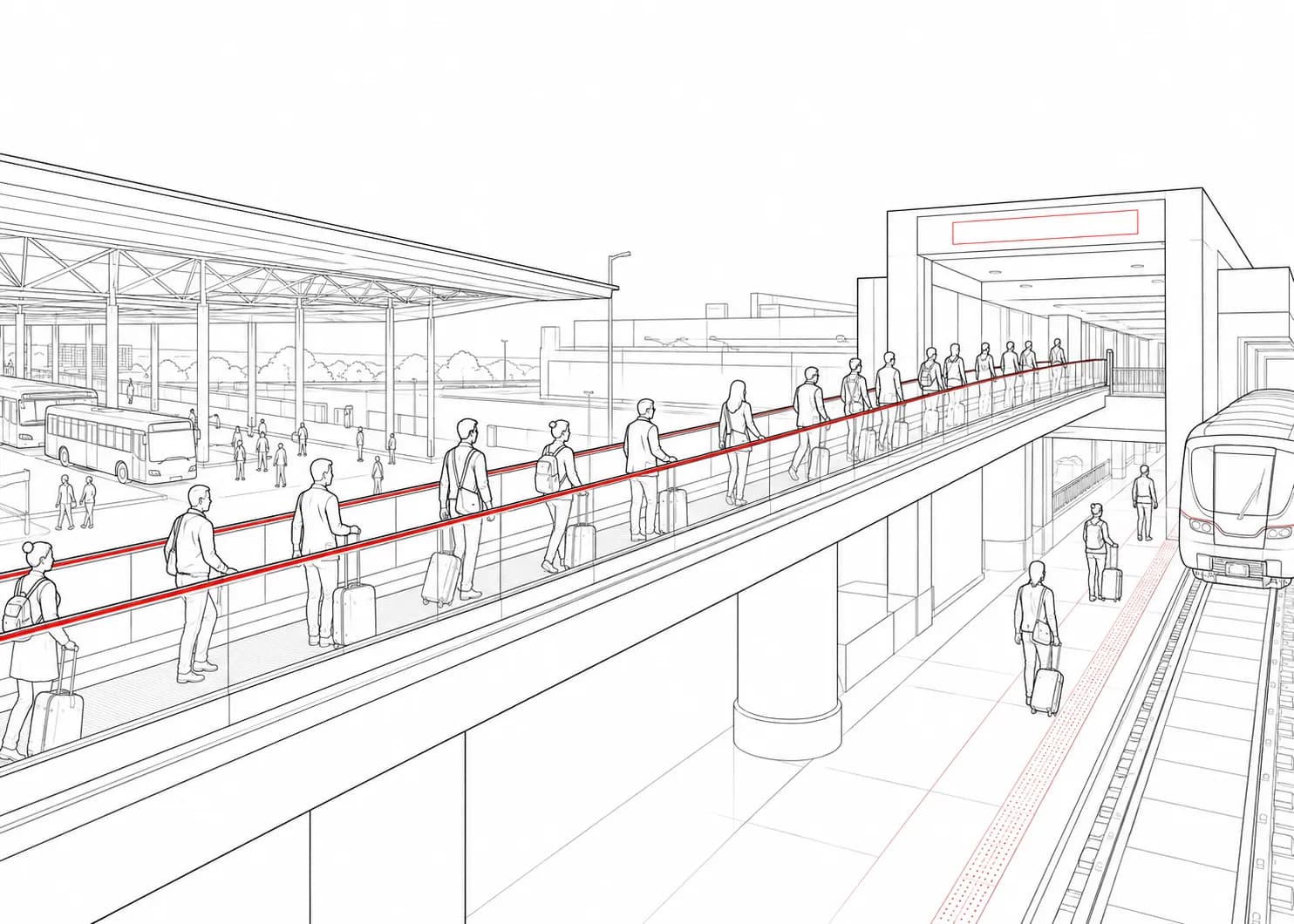
Image — multimodal interchange link
Image — semi-enclosed outdoor circulation link

Why it suits those applications

Infrastructure runs are long, continuously loaded and frequently outside, so truss treatment, chain protection and enclosure sealing determine service life rather than the visible finish. These estates also carry many units across a large footprint, so a fault has to be visible from a control room rather than found by walking the run.

  • Hot-dip galvanised truss, sealed rollers, Dacromet-treated chain and corrosion-resistant fasteners for outdoor and semi-exposed positions.
  • IP54 controller and IP55 motor, with pit water-level detection, oil-water separator and machine room fan supplied as standard on outdoor units.
  • 900 mm balustrade height engineered for transit-density passenger crowd protection.
  • Anti-bouncer mechanism restrains vertical pallet movement on long, continuously loaded runs, reducing ride roughness and mechanical wear.
  • Remote monitor providing UP, DOWN, STOP and INSPECTION signals for integration into building management or terminal control systems.
  • Extended modular installation in continuous spans up to 150 m, with the truss supplied in transportable subsections assembled on site.
Side By Side

Heavy-duty or commercial — which do you need?

ParameterHeavy-Duty TravelatorCommercial Travelator
Specified forTransit and public infrastructure under sustained loadRetail and commercial buildings on trading or office hours
Operating environmentIndoor, semi-enclosed and outdoorIndoor
Traffic profileContinuous, high-volume, with peak surgesHigh but predictable, tied to trading or working hours
Truss treatmentHot-dip galvanisedPainted or galvanised
Weather protectionSealed rollers, Dacromet chain, pit water detection, oil-water separator, IP54 controller, IP55 motorNot required indoors
Balustrade height900 mmTo project requirement (standard 900/1000 mm)
MonitoringRemote monitor for BMS or terminal control, normally a requirementFault display at the machine; remote monitor optional
Typical runLong continuous level links across concourses and interchangesLevel changes between retail floors; parking-to-retail links
Typical applicationsAirports, multimodal interchanges, high-footfall public complexesMalls, hypermarkets, exhibition centres, IT parks, office campuses

Gradient is a configuration within both classes, not a class in itself. Inclination options are set out under travelator specifications.

Applications

Where travelators earn their floor area

Image — airport concourse, level travelator run
01

Airports

Long concourses, inter-terminal links and connections between check-in, security and gates. Level runs carry passengers with wheeled cabin baggage across distances that would otherwise be a real fatigue burden; inclined units move baggage carts between levels.

Image — multimodal link between a transit terminal and an adjoining station
02

Multimodal integration

Travelators connect different modes of transport and the buildings around them: a railway station to a metro or rapid-transit station, a bus terminal to a Namo Bharat or metro platform, a transit hub to an adjoining commercial or public facility. A travelator carries that distance so the transfer stays continuous.

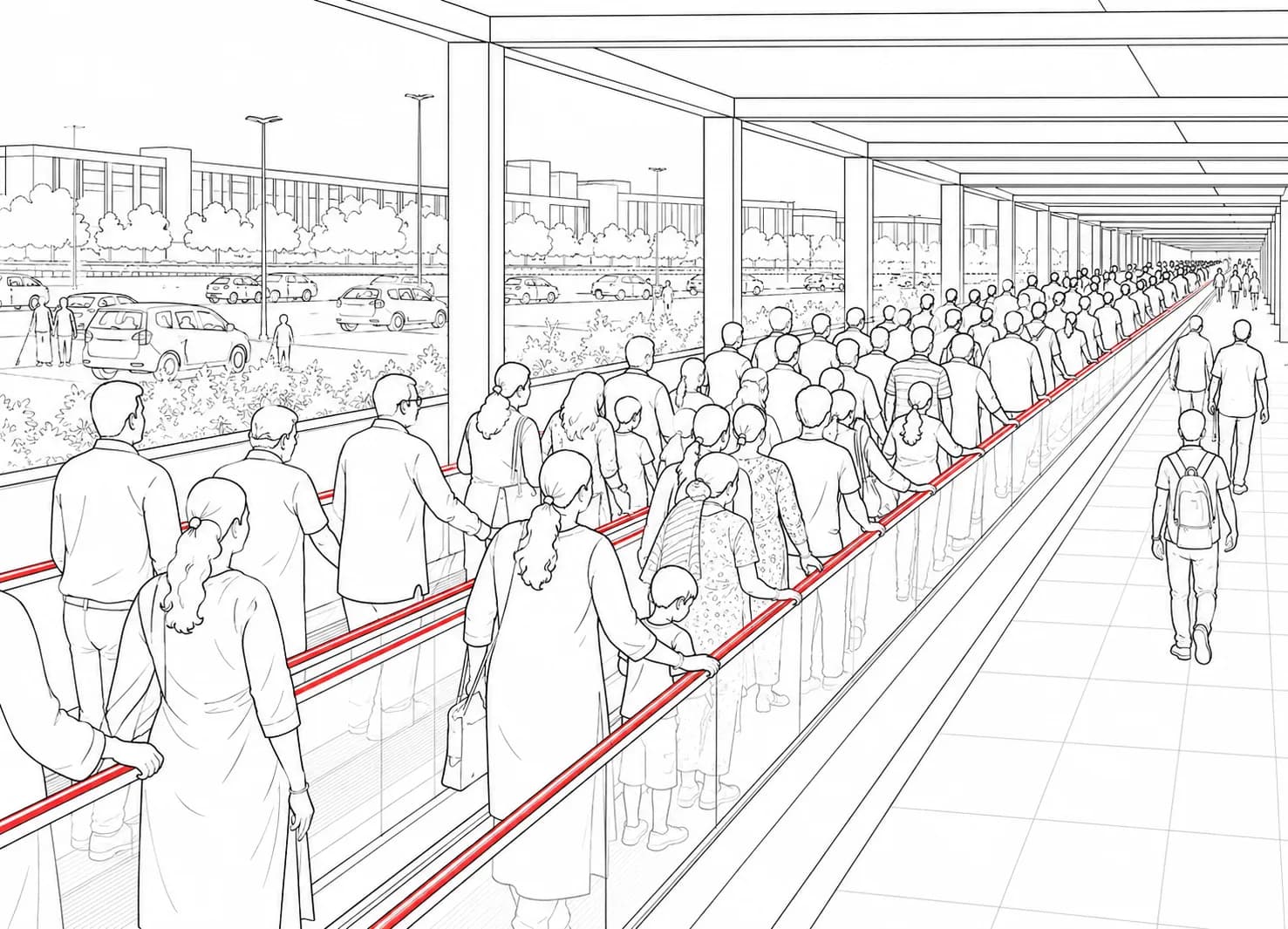
Image — high-footfall public complex, visitor flow
03

Crowded & high-footfall spaces

Large religious complexes, convention venues, public complexes and major visitor destinations, where people cover long distances between parking, entry gates, main premises and exit routes in dense, continuous flow. A travelator holds that movement at a steady pace and takes the walking load off elderly visitors and families.

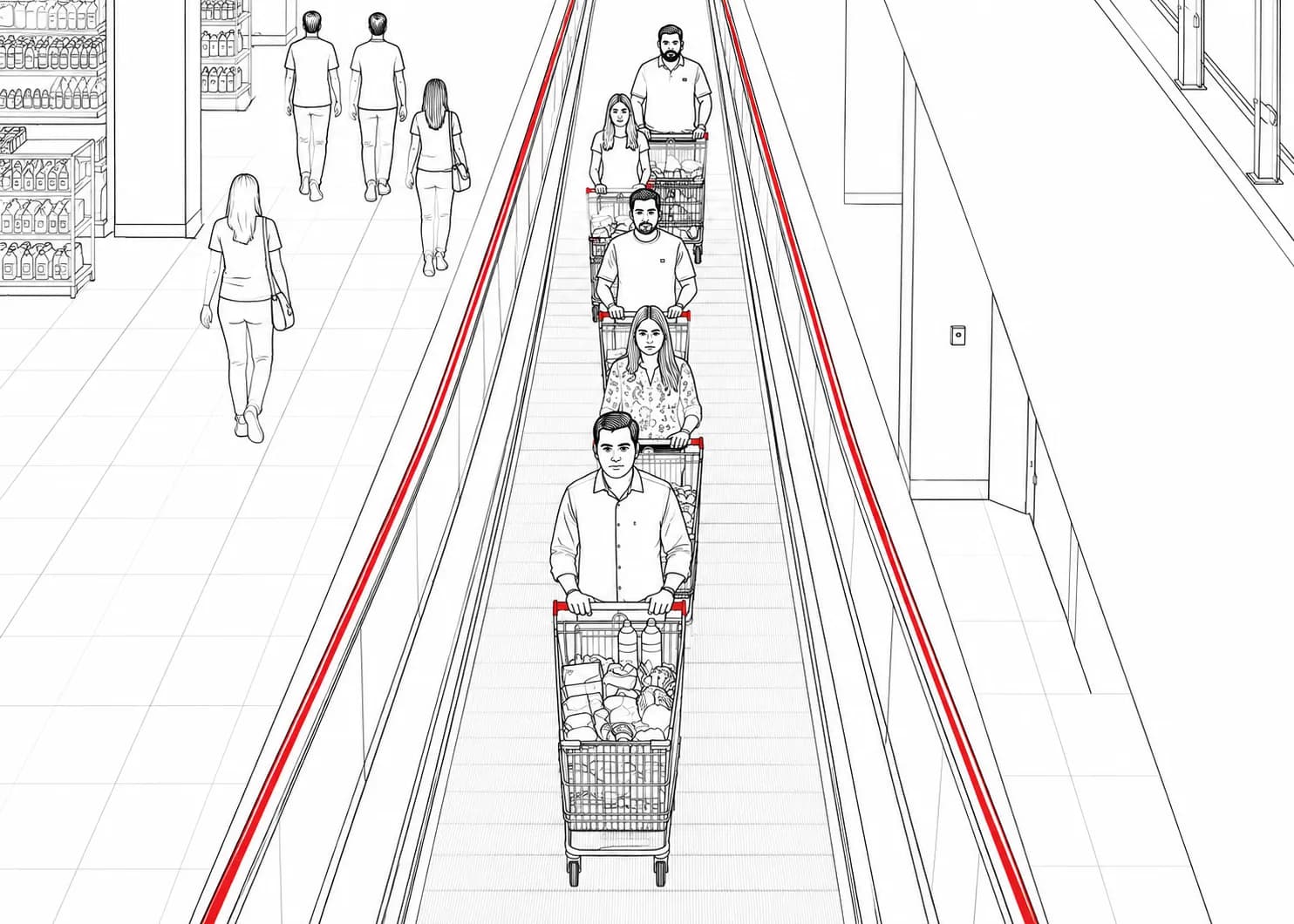
Image — hypermarket, loaded trolley on an inclined unit
04

Shopping malls & hypermarkets

Inclined units connect retail levels while shoppers keep their trolleys. In large single-level formats, level runs link distant zones or connect parking decks to the retail floor.

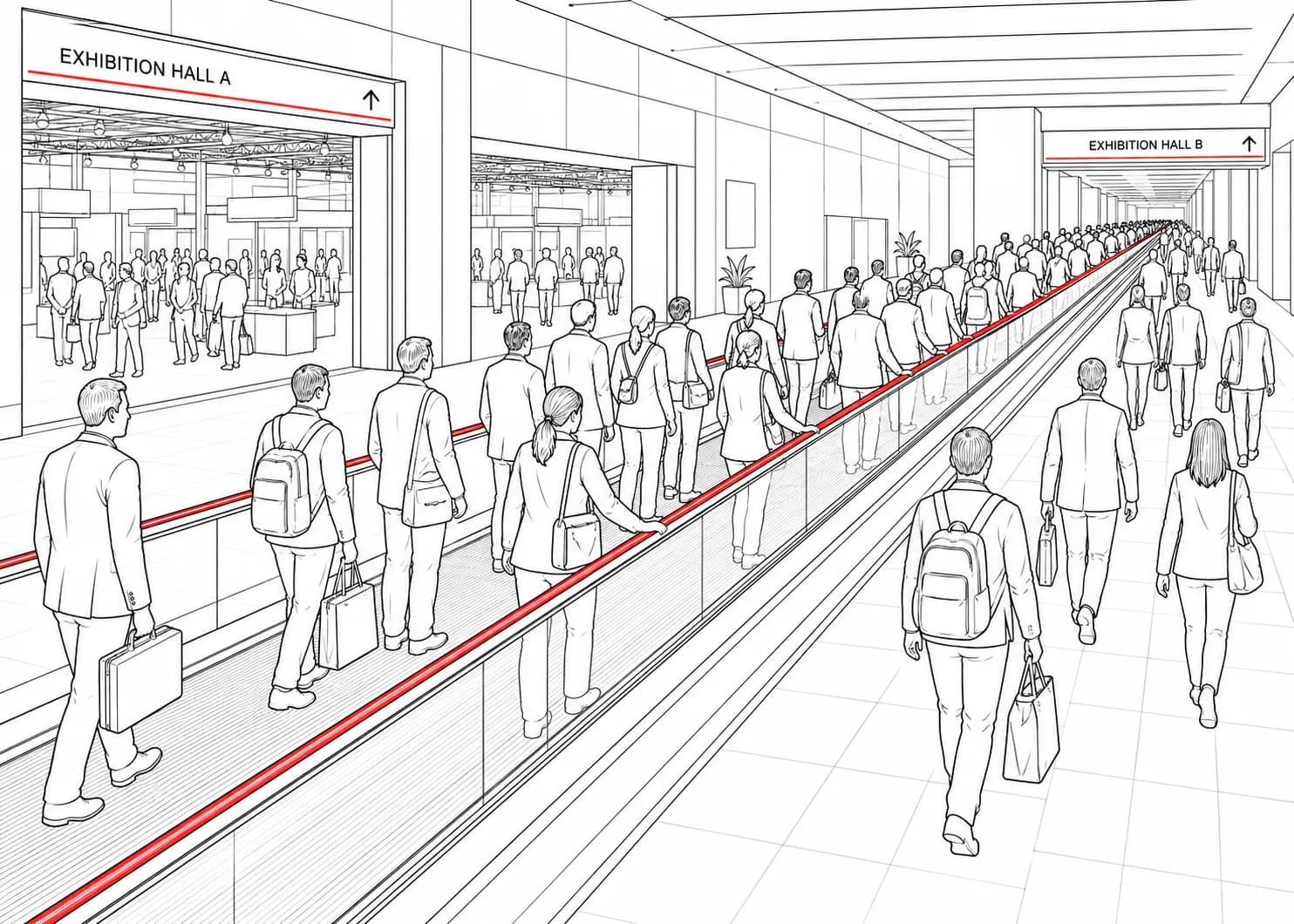
Image — exhibition hall link at peak flow
05

Exhibition centres

Extended halls and links between them, with high peak flow during opening and closing and visitors carrying material, samples and cases.

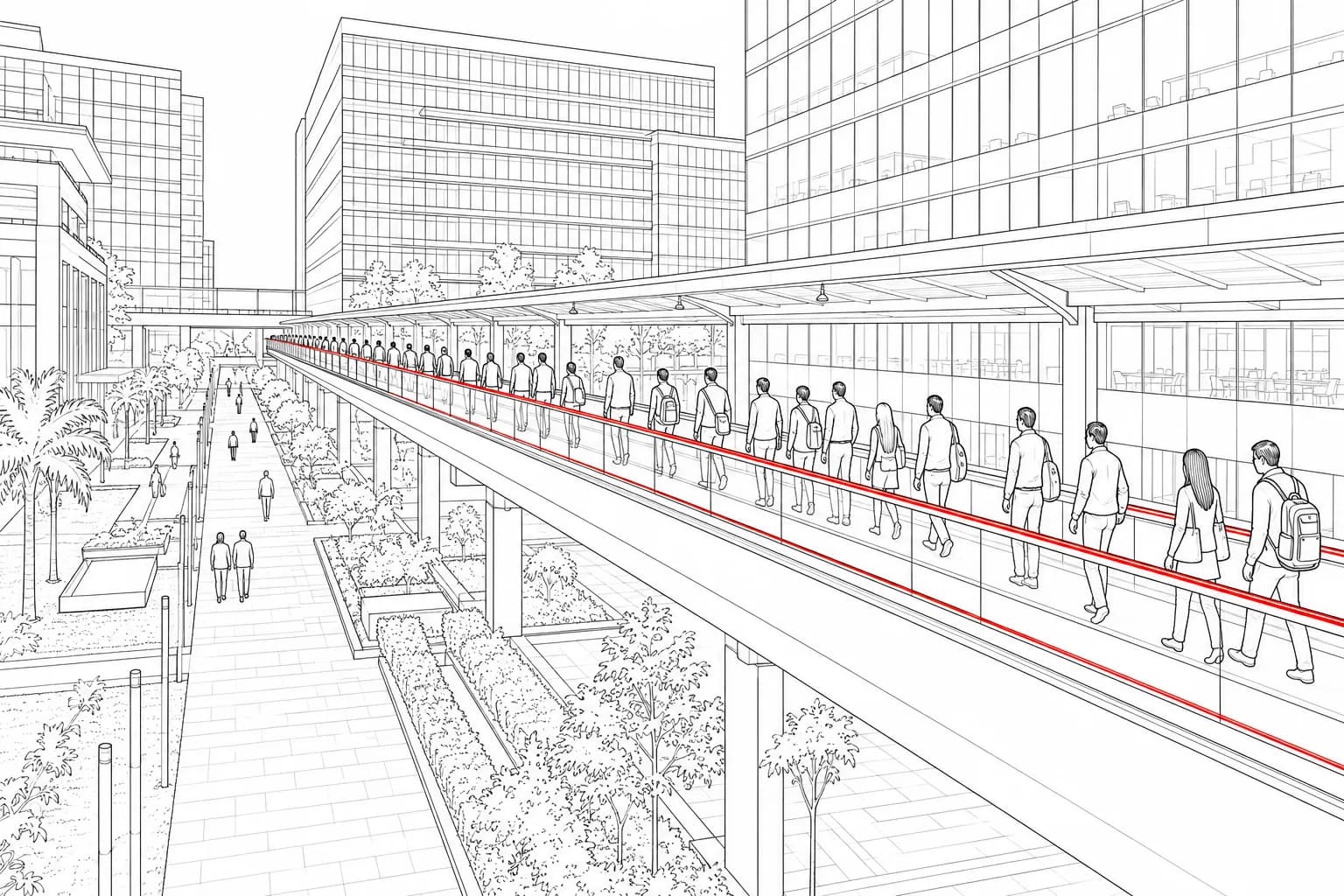
Image — IT park circulation spine between towers
06

IT parks & office campuses

Long circulation spines between towers and connections from parking structures to lobbies, where a large population makes the same walk twice a day at the same time.

Specifications

Travelator specifications

The figures below cover Omega's standard moving walk parameters and the systems supplied with each unit. Every unit is configured to project drawings — treat these as the selection envelope, not a fixed model list.

Duty classHeavy-duty · Commercial
Inclination0° · 6° · 12°
Rated speed0.5 m/s; up to 0.75 m/s in some applications
Maximum installable length150 m
Pallet width600 / 800 / 1000 / 1200 / 1400 mm
Balustrade height900 mm in heavy duty
ArrangementSingle; paired installations for bidirectional flow
TrussStructural angle steel, galvanised; supplied in transportable subsections on long runs
Safety

Standard safety devices

Omega's moving walks carry the same standard safety device set as its escalators — supplied as standard, not as an options list.

DeviceFunction
Microwave sensor at entranceDetects approach for automatic start
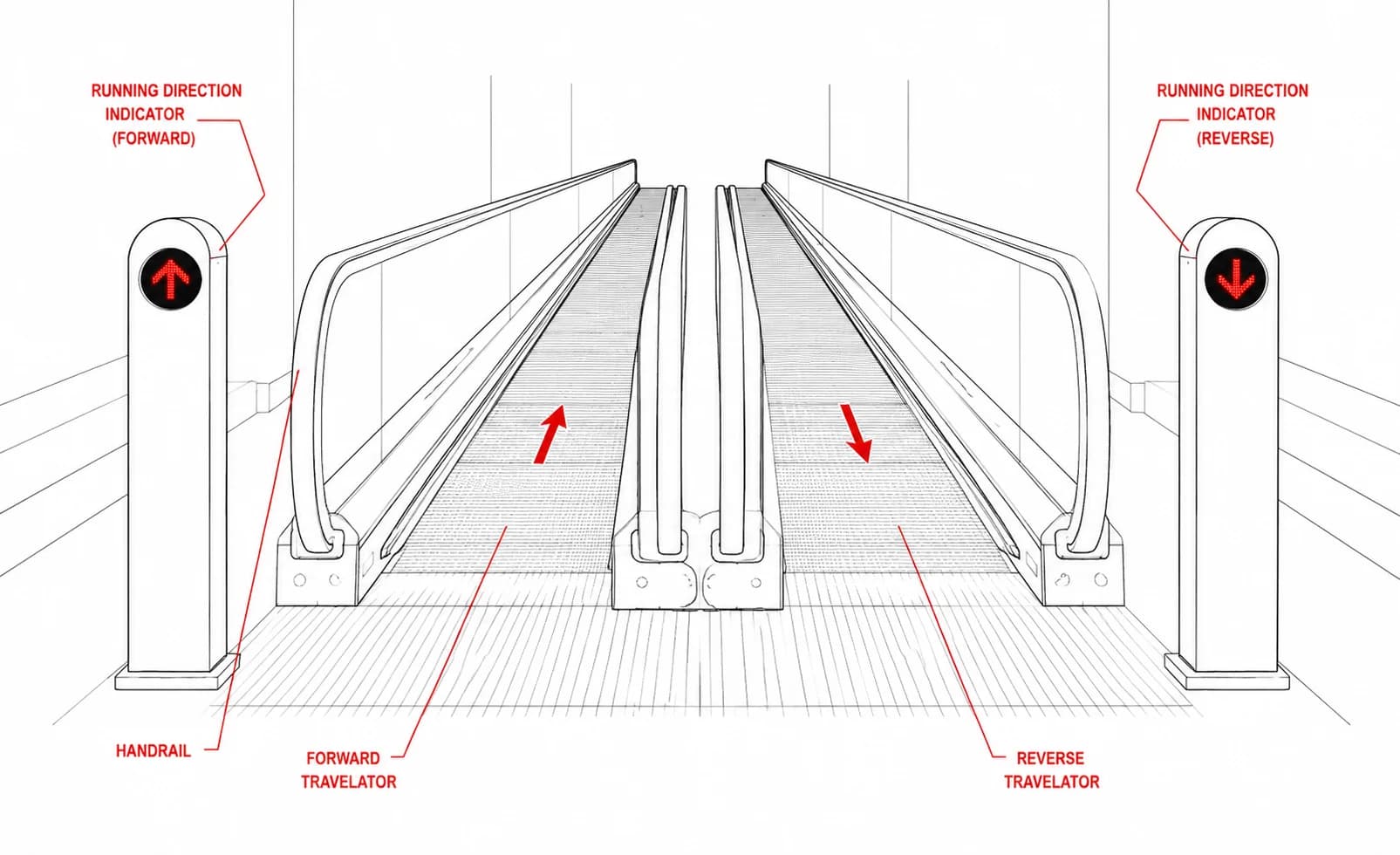
Running direction indicatorShows direction of travel at the landing
Key switch on skirtingAuthorised operation and direction control
Error display on controllerFault codes for rapid diagnosis
Handrail speed monitorDetects handrail/pallet speed divergence
Handrail entrance contactStops the unit if an object enters the handrail inlet
Comb contactStops the unit on comb plate obstruction or impact
Chain contactDetects chain elongation or slack
Pallet sinking contactDetects a pallet dropping below the running surface
Pallet missing detectorStops the unit if a pallet is absent from the band
Anti-reverse devicePrevents unintended reversal
Static brushDischarges static from the pallet band
Broken drive-chain contactStops the unit on drive chain failure
Landing plate opening contactStops the unit if a landing plate is lifted
Machine room fanDrive enclosure thermal management (standard on outdoor)
Water detectorWater ingress detection (standard on outdoor)
Skirting brushReduces entrapment risk at the pallet/skirt interface (optional on moving walks)
Inspection console & lampSupplied one per five units, minimum one per project
Configuration

Configure the travelator to the project

A heavy-duty concourse run and a commercial trolley walkway in a hypermarket are the same product family and share almost nothing else. Omega's moving walks are configured across three layers — the machine, the safety and monitoring options and the visible finish. Available options vary with project requirements, site conditions, product configuration and applicable standards, and are confirmed during design.

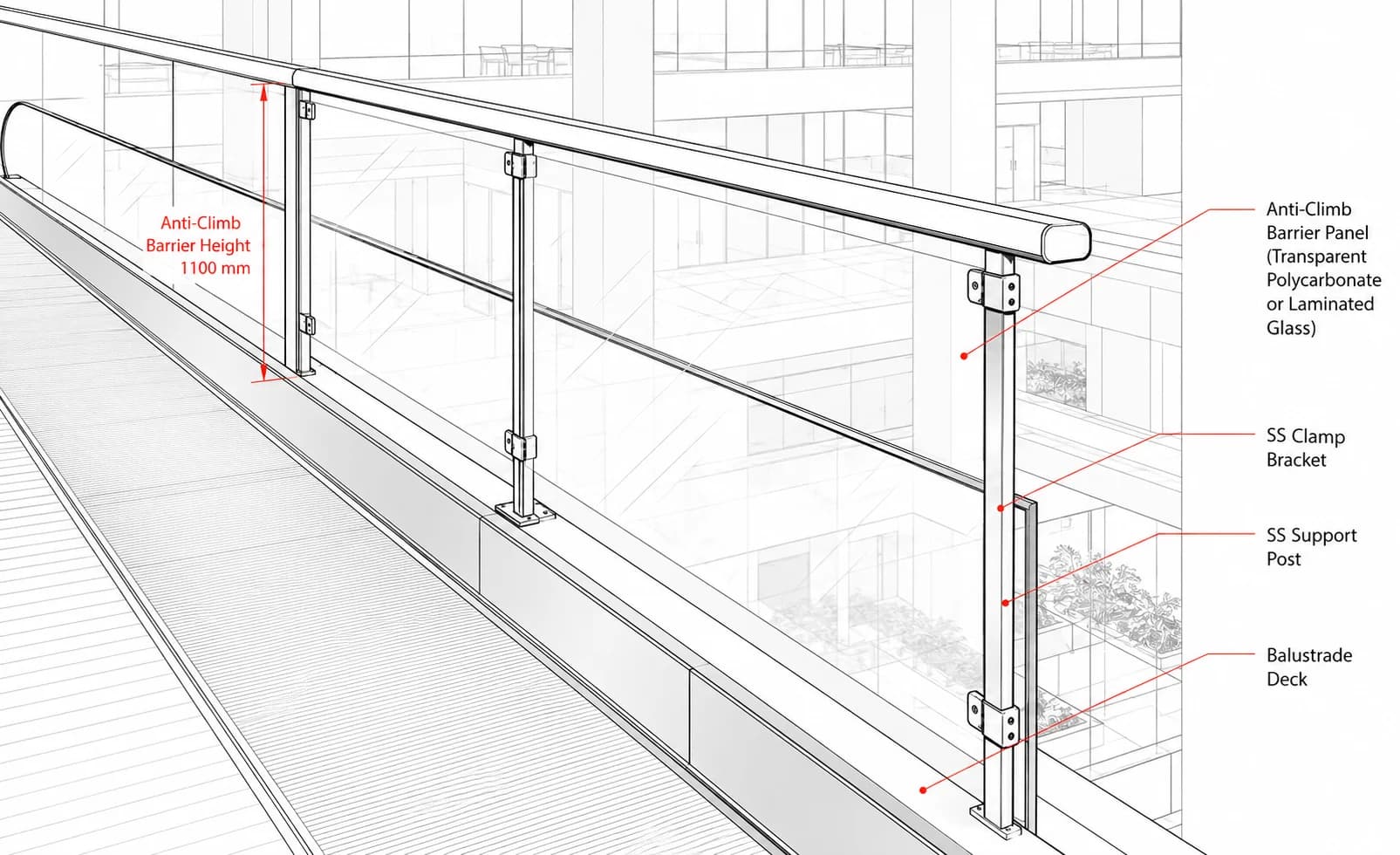
Image — anti-climb barrier panel at the deck

Anti-climb barrier panels

Panels preventing passengers, usually children, from climbing onto or over the balustrade at the deck. Relevant where the unit runs alongside an open void or through an atrium.

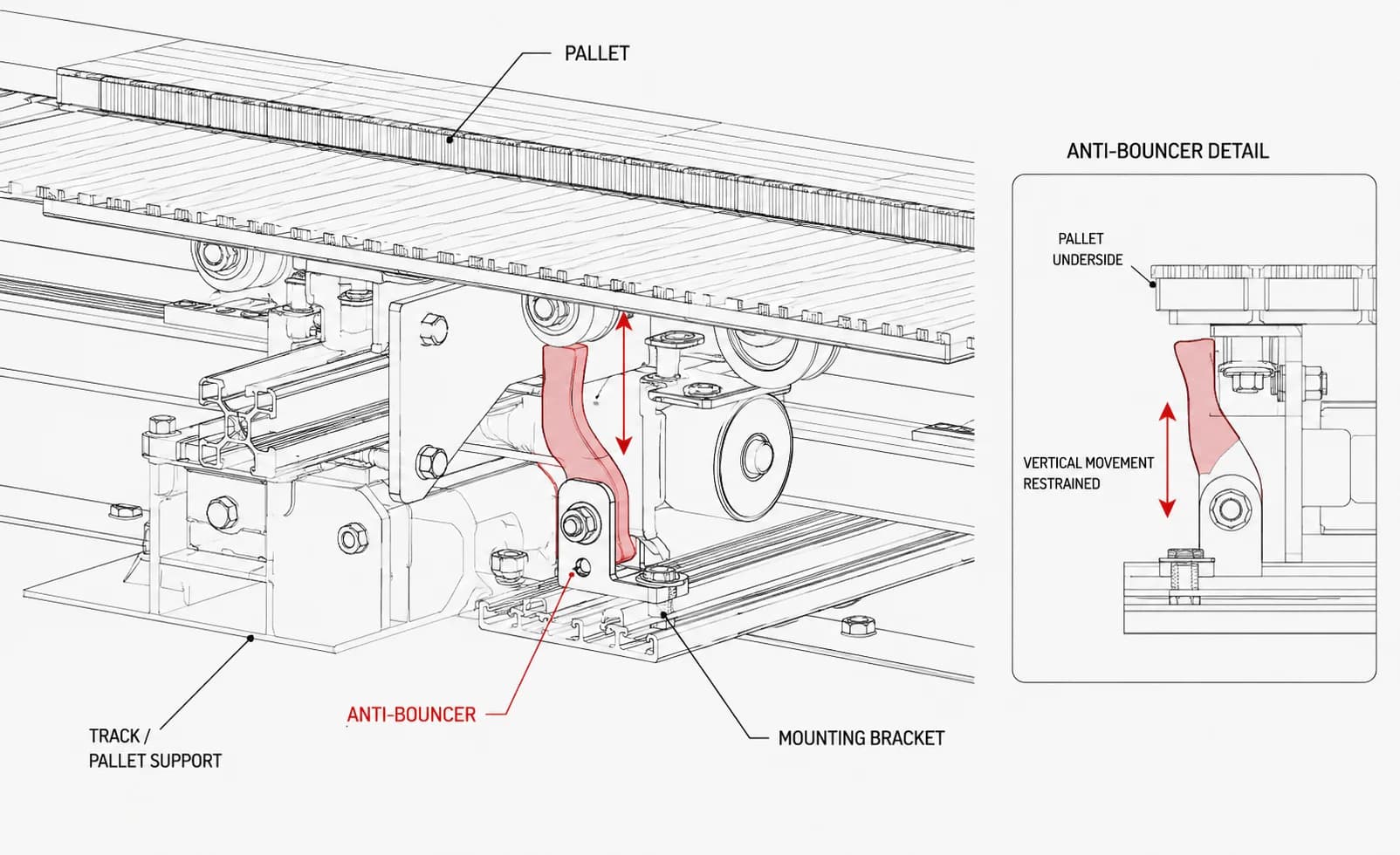
Image — anti-bouncer inside the truss

Anti-bouncer

Restrains vertical pallet movement under load. Reduces ride roughness and mechanical wear on long, continuously loaded runs — the duty profile of a heavy-duty concourse unit.

Image — running direction indicator at the entrance

Running direction indicator at both entrances

Shows direction of travel before the passenger commits. Especially valuable for paired-level installations, where two adjacent units run in opposite directions and a passenger approaching mid-corridor has to choose correctly.

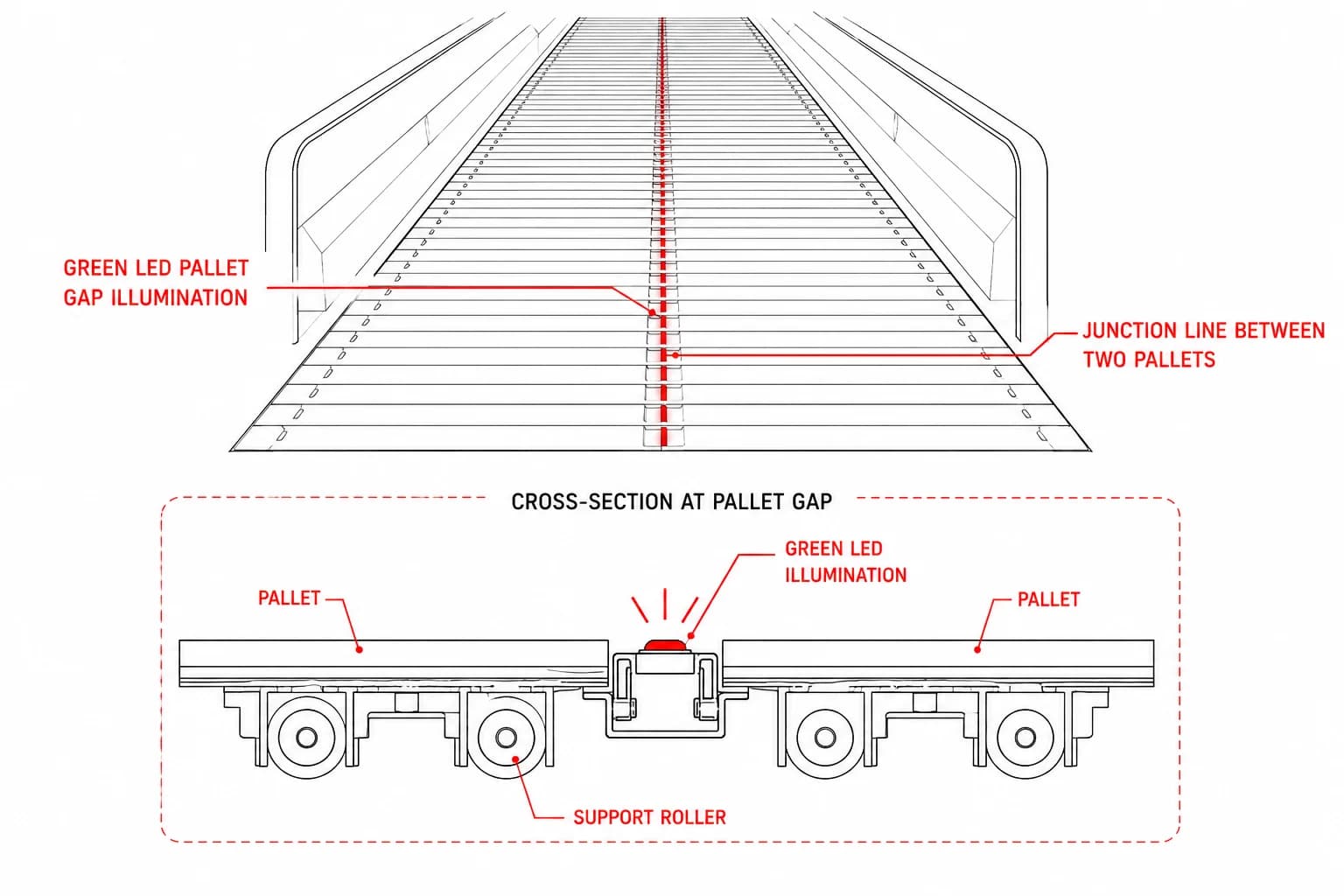
Image — green LED pallet gap illumination

Pallet gap illumination (green LED)

Illuminates the pallet junction line so the boarding edge is visible. High-value, low-cost safety option in dimly lit or high-throughput environments.

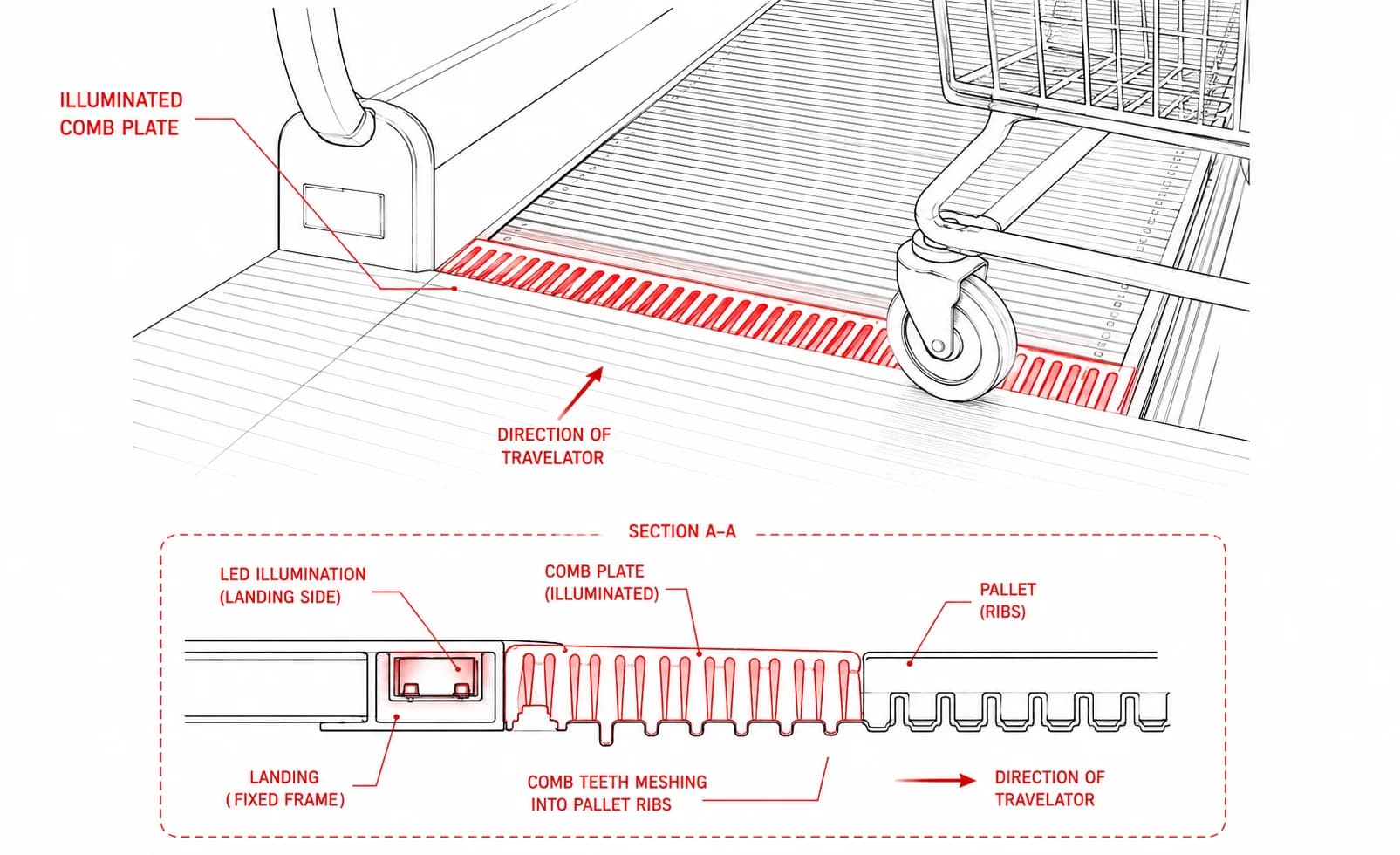
Image — illuminated comb plate at boarding

Comb illumination at both entrances

Lights the comb plate at boarding and alighting — the two points where footing and trolley-wheel errors occur.

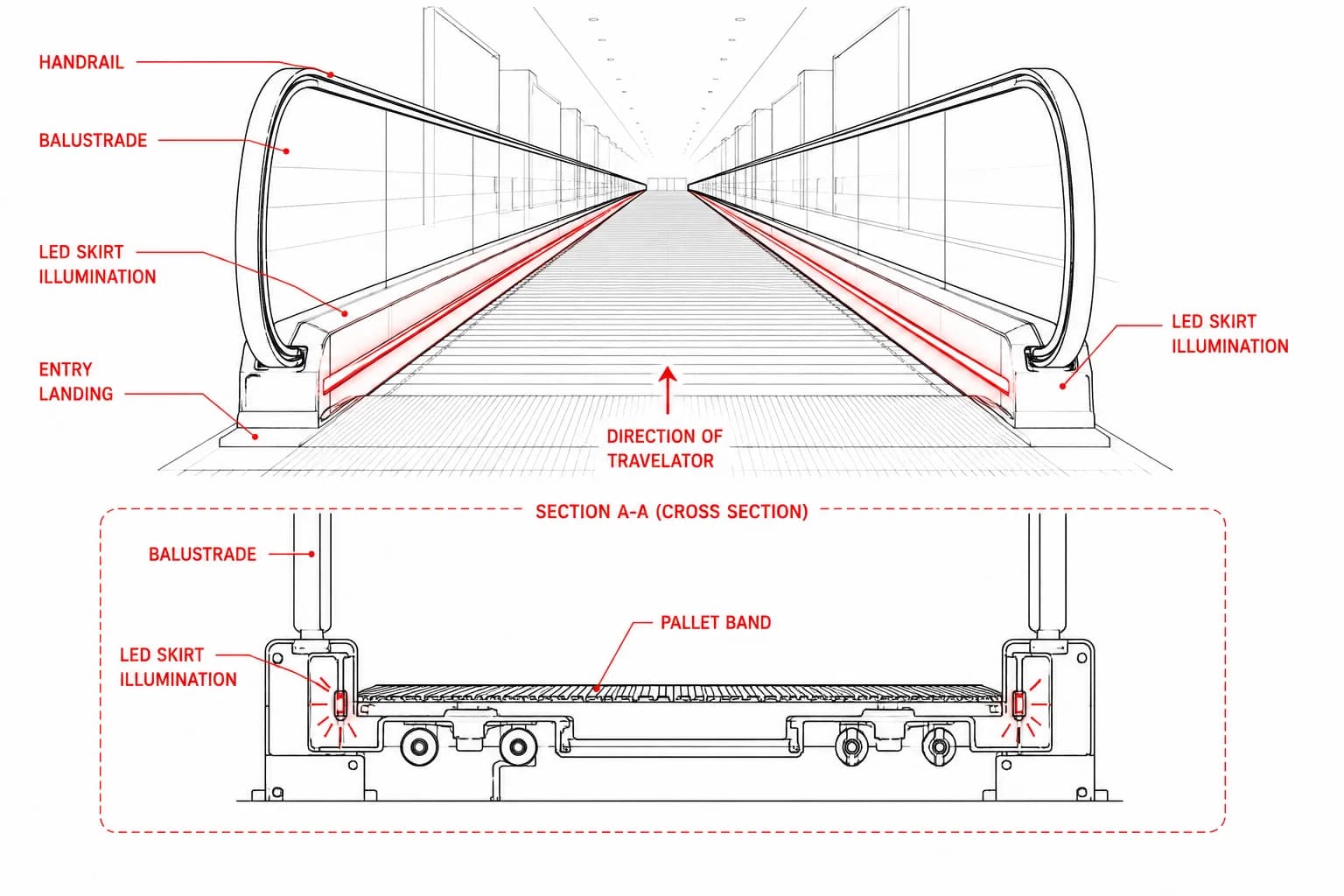
Image — LED skirt illumination along the run

Skirt illumination (LED)

Continuous illumination along the skirting line. Primarily architectural and effective at giving a long run visual definition in a large open concourse.

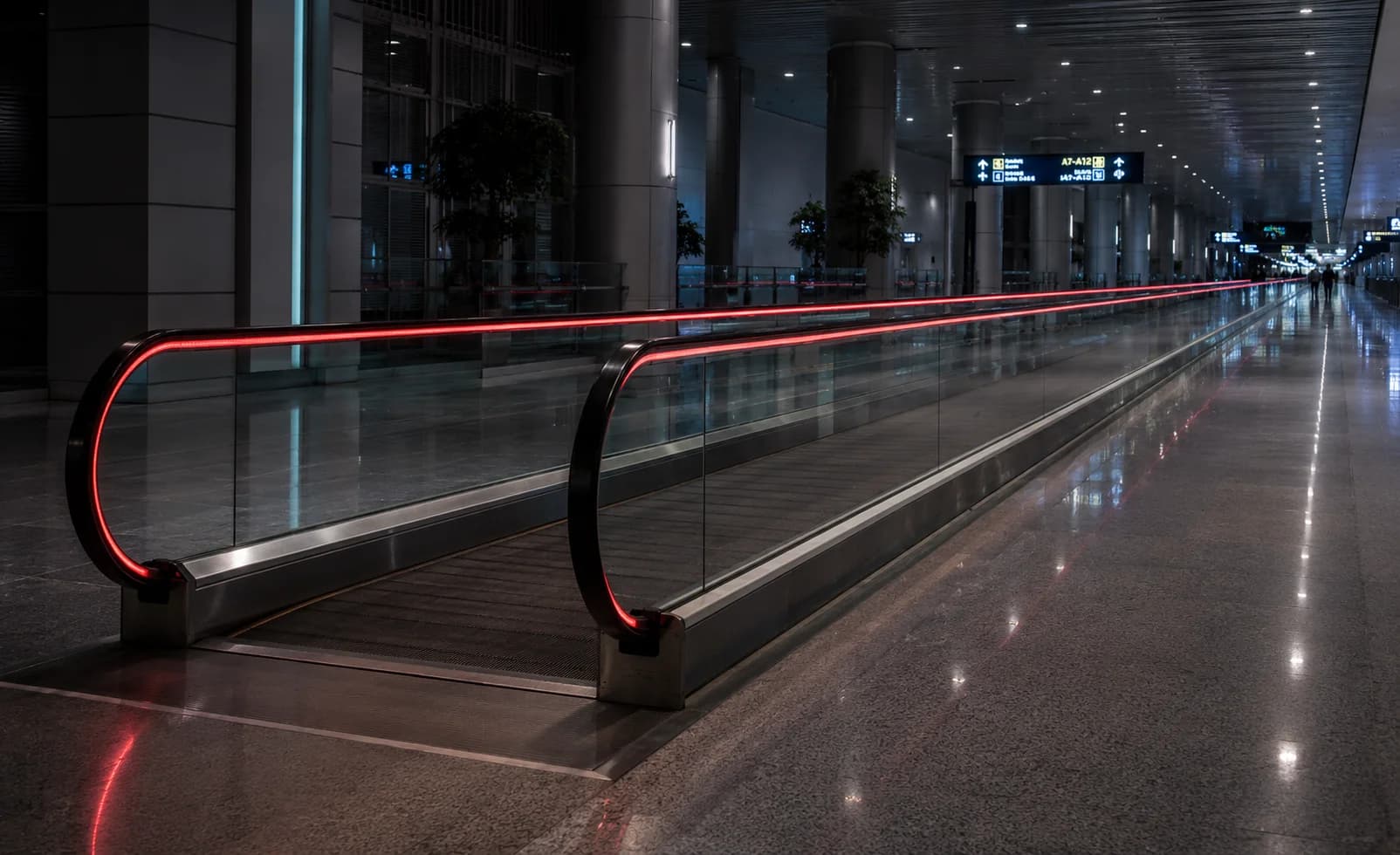
Image — LED handrail illumination

Handrail illumination (LED)

Illuminates the handrail line. Architectural in intent and useful for making a long run legible as a wayfinding element across distance.

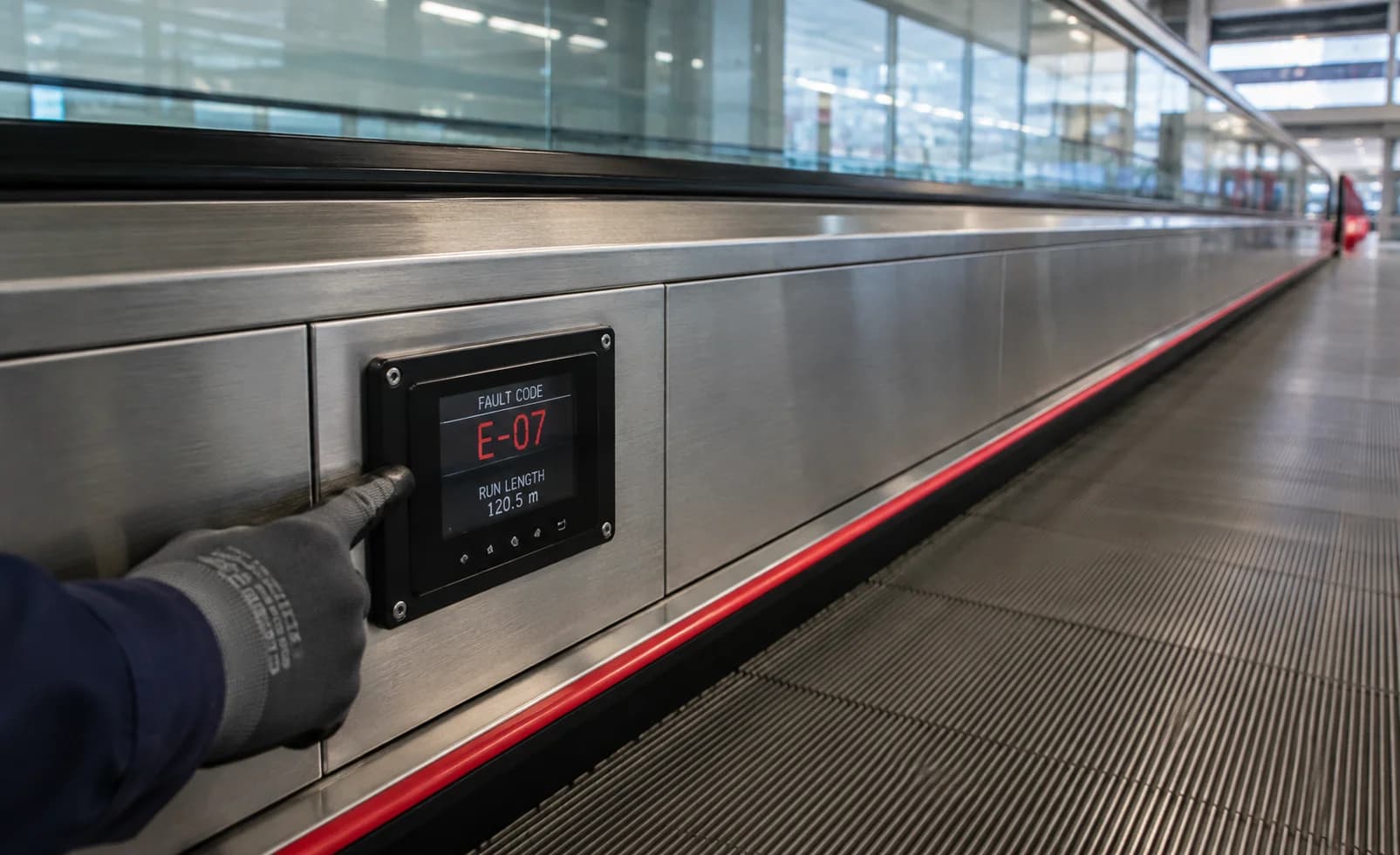
Image — fault display on the skirting

Fault display on skirting

Surfaces fault codes at the machine rather than only at the controller. On a long run, this saves the maintenance team from walking the length of the unit to find out what stopped it.

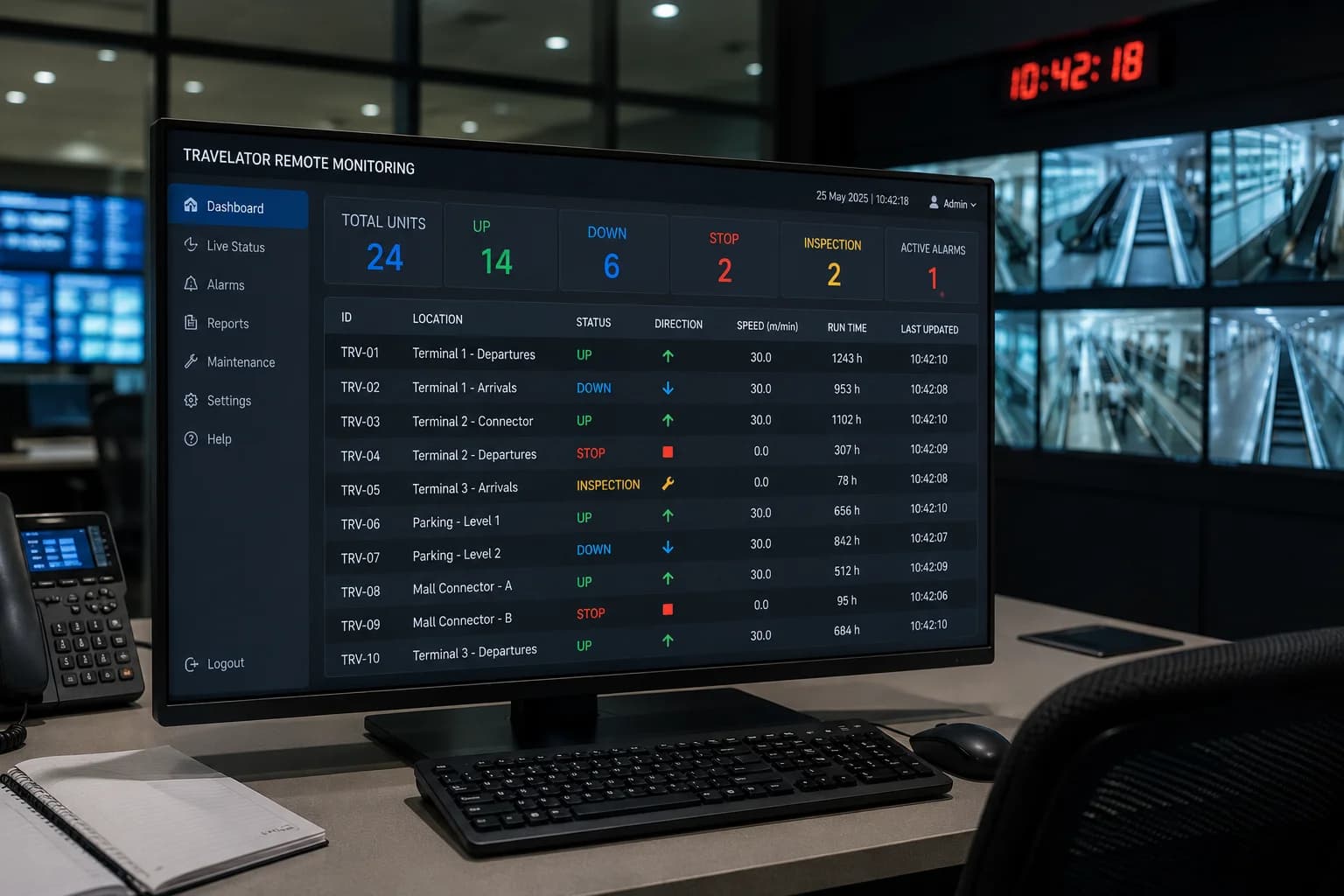
Image — remote monitor with UP / DOWN / STOP / INSPECTION signals

Remote monitor

Provides four contactors and four status signals — UP, DOWN, STOP and INSPECTION — for integration into a building management or terminal control system. On airport and multimodal estates with many units across a large footprint, this is normally a requirement rather than an option.

FAQs

Travelator FAQs

The questions architects, consultants and infrastructure teams ask most often when evaluating moving walks.

Ask our engineering team

A travelator, also called a moving walk or moving walkway, is a motor-driven conveyor that carries passengers along a horizontal path or a gentle incline of up to 12 degrees. It uses a continuous band of flat pallets rather than steps, so luggage trolleys, shopping carts and strollers can be taken onto it.

An escalator uses moving steps on a 30–35° incline to move passengers between floors in a compact footprint. A travelator uses flat pallets on a horizontal path or an incline up to 12°, so wheeled items travel with the passenger. Achieving the same rise with a travelator needs a much longer installation.

Travelators are used in airports, multimodal transit interchanges, shopping malls and hypermarkets, exhibition centres, IT parks and office campuses, and large public and high-footfall complexes — wherever passengers cover long level distances, or need to change level while carrying luggage, shopping trolleys or strollers.

A heavy-duty travelator is built for transit and public infrastructure: long continuous runs, sustained loading, indoor or exposed positions, a hot-dip galvanised truss with the outdoor protection package, 900 mm balustrade and remote monitoring. A commercial travelator is built for indoor retail and commercial buildings on trading or office hours, where trolley compatibility, ride comfort and finish carry more weight. Both share the same pallet band, control architecture and standard safety device set.

Wherever two transport modes or connected facilities sit far enough apart that the walk between them undermines the journey — a railway station to a metro station, a bus terminal to a Namo Bharat or metro platform, a transit hub to an adjoining public building. A travelator carries that distance so the interchange reads as one continuous journey.

The maximum inclination is approximately 12 degrees under the governing safety standards. Omega supplies inclined moving walks at 0°, 6° and 12°. Because the gradient is limited, achieving a given rise requires a substantially longer installation than an escalator would need — run length has to be planned for early.

Yes — that is the primary reason inclined moving walks are specified in retail. The flat pallet surface allows a loaded trolley to travel between levels with its user, unlike an escalator. Trolley compatibility depends on the trolley type and the unit's configuration and is confirmed during design.

Inclined moving walks are supplied in 800, 1000, 1200 and 1400 mm pallet widths. Wider pallets accommodate a trolley and its user side by side and raise throughput, at the cost of a larger structural opening. Width on retail units is usually driven by trolley dimensions rather than passenger count.

Travelators typically run at 0.5 m/s, with up to 0.65 m/s used in some applications. 0.5 m/s suits mixed passenger populations and makes boarding and alighting comfortable; 0.65 m/s raises throughput on long level runs used mainly by able-bodied travellers.

Moving walks are routinely installed in long continuous runs, with the truss supplied in transportable sections and assembled on site. Maximum length for a given project is confirmed against structural drawings.

Yes. Outdoor moving walks use a hot-dip galvanised truss, sealed rollers, Dacromet-treated chain, corrosion-resistant fasteners, pit water-level detection and an oil-water separator, with an IP54 controller and IP55 motor. A canopy over the unit is also required as part of the building's civil scope.

They are the same product. "Travelator" is the common term in India and general usage; "moving walk" is the term used in metro, railway and airport tender documents and "moving walkway" is common internationally. Manufacturer and standards literature also uses "autowalk" and "passenger conveyor".

Omega moving walks carry a full standard safety package including handrail speed monitoring, comb contact, chain contact, pallet sinking contact, pallet missing detection, anti-reverse protection, broken drive-chain contact, landing plate opening contact and an error display on the controller.

The civil contractor provides the wellway and trench structure, supports, pits, waterproofing and drainage, FFL marking, site access for long truss sections, architectural handrails, canopy in open areas and signage. The E&M contractor provides three-phase supply to an isolator, lighting, earthing, UPS supply for comb and pallet gap lights, raceways, fire signal input and a fire water connection.

Start A Project

Let's plan the right travelator for your project

Send us the run length available, any level change and an idea of your peak footfall — including whether passengers will be bringing trolleys. Omega's application engineers will come back with a recommended duty class, gradient, width and configuration, along with the drawing set your team needs to coordinate it.

AhmedabadIn-house manufacturing
Make in
India
Designed & built locally
+91 75
758 66362
Speak to an engineer
info@omega-elevators.comEmail the team

Replies come from an Omega application engineer, usually within one working day.

Changing floors rather than covering distance?

Omega escalators — heavy-duty and commercial, 600–1000 mm step widths, parallel, crisscross and curved.

View escalators